Procurement
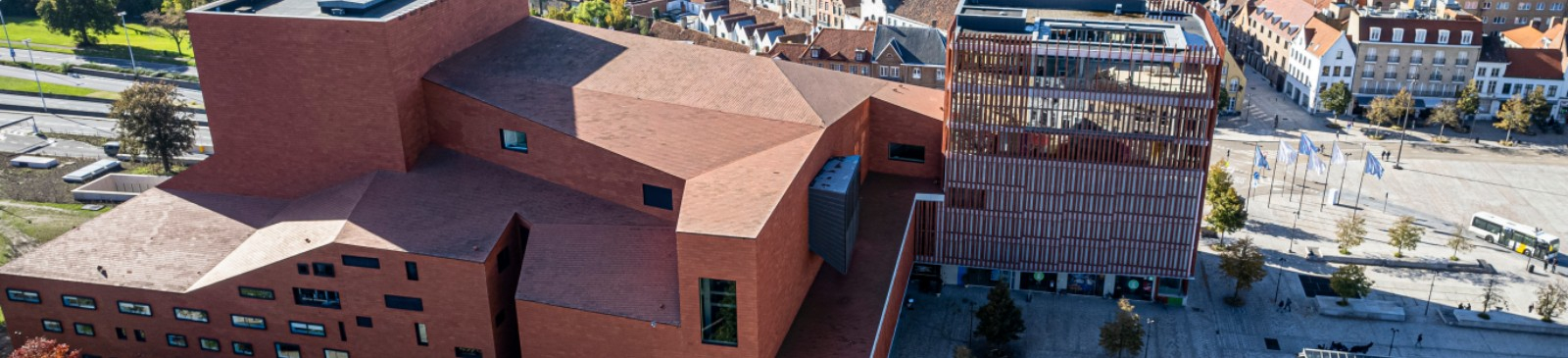
The Concertgebouw Brugge has opted for an innovation partnership to replace the current façade cladding with (partly) Building Integrated Photovoltaics (BIPV). The innovation partnership consists of several phases.
The innovation partnership consists of three phases:
- Study phase (2–3 innovation partners);
- Living lab phase (1 innovation partner);
- Commercialisation and maintenance phase.
The study phase will start with a thorough theoretical study. This includes both the BIPV solution and the necessary studies on façade construction, architecture, structural stability, technical systems, and an exploratory study with the grid operator. Afterwards, both consortia will develop and present a prototype, and finally realise a test setup on a limited surface area of the building. A maximum fee of €75,000 per partner is foreseen for the study phase.
Based on the results of the study phase and the revised tender, the Concertgebouw will grant one innovation partner access to the living lab phase. In this living lab phase, the innovation partner will test the solution on 10–15% of the Concertgebouw’s building envelope.
Based on the results of the living lab phase and a possible revised tender, the Concertgebouw will decide on the award of the commercialisation and maintenance phase, which will not receive PIO co-financing.
The selection guidelines were published on 30 October 2024. The specifications are available on eProcurement. An information session about this assignment took place on 29 November. The applications had to be submitted by 12:00 on 15 January 2025.
Based on the applications received, the Concertgebouw invited four consortia to submit a tender. Two consortia were selected to start the first phase of the innovation partnership. The first consortium consists of contractor Artes Depret, product developer Saint-Gobain Solutions, and architectural engineering firm Bureau Bouwtechniek. The second consortium is a collaboration between contractor CIT Blaton, product developer Soltech, and architectural engineering firm Sunsoak.